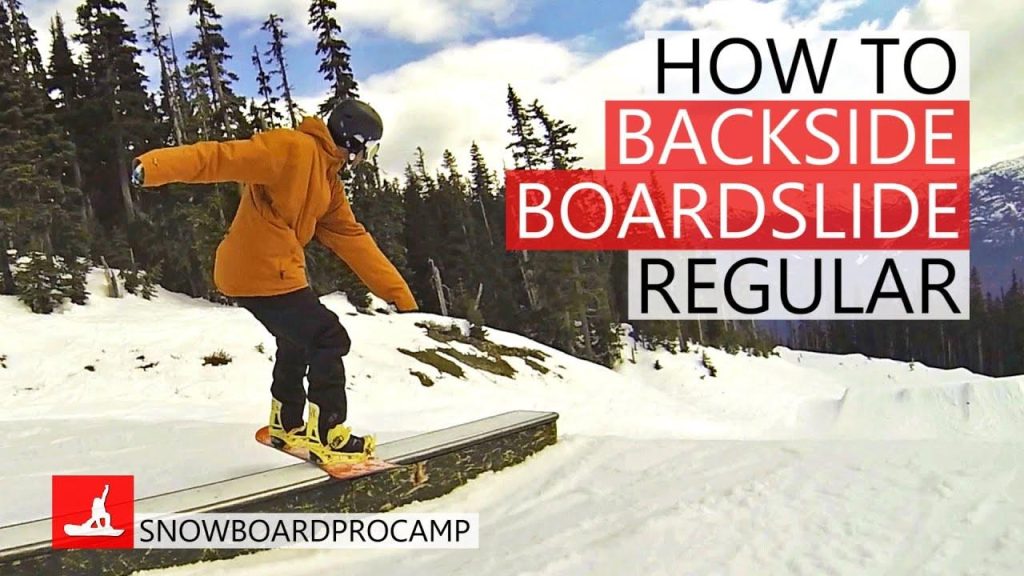
The 50-50 is the first rail trick, and it is also the one everything else is built from. Get it properly and boardslides, lipslides, 180s on and 180s off all become variations of something you already do.
Here is the short answer. A 50-50 is not really a trick, it is a stance. Knees flexed, back straight, weight centred over the board, head up and looking down the feature rather than at your feet, and your whole body lined up with the board. Ride onto a low wide box with a flat base and absolutely no edge, hold that position, and ride off the end.
The work happens before you ever touch a box, on flat snow and on a stick you borrowed from the side of the piste.
Watch it first
Snowboard Addiction is the source, with Nev Lapwood presenting and Dan Gersner demonstrating. It runs about ten minutes and it is one of the most complete explanations of a 50-50 anywhere.
Two things to know before you press play. Nev says at the start that this is an older version of their tutorial, released free, and there is an updated one on their own site. And it is filmed in two versions, regular and goofy, so pick the one that matches your stance and the whole thing mirrors correctly for you.
If you want to skip around: the body position is at 1:04, flat-base practice on snow at 1:59, target practice at 2:25, your first real box at 3:39, adjusting for down and kinked features at 5:09, ollieing on frontside and backside at 6:21, and 180s off the end at 8:03.
Using the code “tricktips” on the Snowboard Addiction website you can get 10% off any of the awesome Snowboard Addiction Tutorials!
Check out some of the Tutorials from Snowboard Addiction on this site to see just how good these pros are at coaching
The solid riding stance
Nev calls it the solid riding stance, and the whole lesson hangs off it.
- Knees flexed, not locked.
- Back straight and upright.
- Body weight centred over the board.
- Head up, looking in your direction of travel. Try not to look down at your board.

Then the part that actually matters most:
Keep your whole body in alignment with the board. Arms, shoulders, hips and knees all lined up in the same direction as the board. Nev is explicit that this is crucial for balance on 50-50s, and that every other trick builds from here.

That is worth taking seriously rather than nodding at. If your shoulders are open to the feature, your board wants to turn off it. Lined up, it wants to keep going straight, which is exactly what a 50-50 is.
Before the park: two drills
This is the part people skip, and it is why they end up sliding off the side of a box on their first go.
1. Ride a completely flat base
On a gentle slope, ride with a completely flat base, using absolutely no edge, holding the solid riding stance.
That is very close to how it feels on a box. Do it several times until it stops feeling precarious.
2. Target practice
Now add aim.
Draw a box in the snow. Line it up, drop in, and 50-50 it. Treat it as if it were real, because as Nev says the actual trick is exactly the same feeling.
Another version: grab a piece of bamboo or a marker from the side of the run, lay it out, line it up and ride it. Put it back afterwards.
Keep doing this until you can comfortably see yourself making the whole feature every time. That is the standard, not “until you get bored”.
Your first real box
Find the smallest, safest feature in the park. A flat, wide box, low to the ground, with a ride-on rather than a gap onto it.
Find a spot where you can drop in straight with a flat base, and avoid doing speed checks as you hit the box. A speed check puts you on an edge, and an edge on a box is how you catch and go down.
Then: keep riding straight, hold the stance, knees flexed, no edge. Ride off the end, regain control on the snow, and come to a stop.
Then get straight back up and do another one. Your confidence jumps enormously after the first success.
Adjusting for the feature
Once you move onto longer and narrower features, two things change.
Look to the end, or past the end, of the feature. Not at your feet, not at the start of the rail. This is what makes you ride the whole length every time.
Your stance stays at 90 degrees to the feature. On a flat box, upright is correct. But on a down box or down rail, your body position has to rotate to match the angle of the feature to stay in balance. The same applies to kinked features.

Curved features like rainbow rails, C boxes and dragon boxes are harder again, because the angle is changing the whole time. Your stance has to stay balanced relative to the feature at every point along it.
Master the stance and you have mastered the features. That is genuinely the whole progression.
Ollieing on, frontside and backside
Bigger rails and boxes need you to ollie on from the side.
Frontside 50-50 is where the feature is in front of your body as you ollie on. Backside is where it is behind you.
Frontside tends to be easier, so try it first.
Practise on a bamboo stick before a real rail. Then:
- Approach at a slight angle, roughly 20 to 30 degrees, because you are coming on from the side rather than straight.
- Do a small, controlled ollie.
- Straighten the board and land gently on the rail with equal weight on both feet.
As you get used to it, you will start landing with the board very slightly angled against the feature, which stops you sliding off the far side, and then flattening the base to slide the length of it. Nev is clear that the angle is very subtle.
Learn both directions. Many more advanced tricks branch from here, and having only one is a dead end.
Adding a 180 off the end
Once the basic 50-50 is comfortable, the simplest way to make it look good is to slap a 180 off the end.
The mechanism is the same for both directions and it is worth understanding rather than memorising. Your upper body starts rotating while your lower body stays locked in the 50-50 position. That winds you up, and at the end of the feature you are spring-loaded, so the lower body comes round quickly.
Frontside 180 off: the upper body opens and rotates around the nose of the board.
Backside 180 off: the upper body rotates towards the tail. This one is trickier, because you rotate blind. Your landing goes out of view, exactly like a backside 180 on snow. Spot the landing blind, then once you have control, resume looking in your new direction of travel.
From there you can 180 on to the feature, or change to a switch 50-50 halfway along it.
All of it is the same idea. Every variation is the solid riding stance, with your upper body deciding what your lower body does.
Frequently Asked Questions
How do you 50-50 on a snowboard?
Hold the solid riding stance: knees flexed, back straight, weight centred, head up, and your whole body lined up with the board. Ride onto a low wide box with a completely flat base and no edge at all, keep riding straight, and ride off the end before you regain control on the snow.
Why do I keep sliding off the side of the box?
Usually an edge. If you speed check as you approach, or tilt the board at all on the feature, it will track off the side. Approach at a speed you do not need to check, and keep the base completely flat.
Where should I look during a 50-50?
At the end of the feature, or past it. Looking down at your board is the most common mistake and it is what makes people come up short.
Is frontside or backside easier to ollie on?
Frontside, where the feature is in front of your body as you ollie on. Try that direction first, but learn both, because most of the more advanced rail tricks branch out from having each one.
How do I practise 50-50s without a park?
Ride a completely flat base on a gentle slope with no edge at all, then draw a box in the snow and ride it as if it were real, or lay a piece of bamboo from the side of the run and ride that. Keep going until you make the full length every time.
How do you 180 off the end of a rail?
Start rotating your upper body while your lower body stays locked in the 50-50 stance. That springloads you, so the board comes round quickly at the end. Frontside rotates around the nose; backside rotates towards the tail and is blind, so you spot the landing late.
In short
Stance, then flat base, then target practice, then the smallest box in the park. Look at the end of the feature, never at your feet, and never touch an edge.
Every other rail trick on this site is a variation of what is on this page, so it is worth over-learning rather than rushing.
Ask any questions in the comments below.