So your 180s are solid, you have spun a 360 off a side hit, and now you want to take spins to the park jumps. This is the article for that.
Here is the short answer. Every spin, from a 360 to a 720, comes off the same approach. One setup turn on the run-in, a carve up the lip on the edge you are spinning from, and the board leaving the lip travelling straight. What changes as the spins get bigger is how hard you release at the lip and where you spot your landing, not the line you ride in on.
We have got Snowboard Addiction’s spinning tutorial below in both stances, plus a short clip of theirs on landings. What follows is the breakdown, with timestamps, of the approach, the release and the landing, and the mistakes that put people on the knuckle.
Why these videos
Most spin tutorials show you a rider throwing a 540 and tell you to rotate harder. This one does not talk about rotating at all for the first nine minutes.
Nev at Snowboard Addiction teaches spinning as edge work. Speed, the platform you spin from, and where you finish your setup turn, with diagrams of the lip showing the line. That is the part nobody else explains, and it is the part that makes every size of spin work.
It is an older video, filmed in 2009, and it looks it. The physics has not changed. It comes in a regular and a goofy version, so pick the one that matches your stance and you are not flipping a mirror image in your head.
If you ride regular
If you ride goofy
What you need first
The video is clear about this at 0:49, and it is right. Before you take spins to park jumps you should be able to do all four 180s on small park jumps, and 360s on side hits.
- If your 180s are not there yet, start with our guide to your first frontside and backside 180. It covers the four ways to spin and which edge each one comes off.
- Side hits are the natural place for your first 360s. Our guide to hitting a hip is a good warm-up for reading a feature at speed.
- And you need to be comfortable hitting the jump with a plain straight air at a proper speed. If the jump itself still frightens you, there is nothing left over for the spin.
The four keys to spinning
At 1:02 Nev names the four things he coaches on every spin.
- The platform. How you use your edges to spin. He calls this the most important one.
- The setup. Where and how you prepare on the run-in.
- The release. When and how you leave the lip.
- The landing. Where to spot it, and how to stop the rotation.
The long video covers speed, the platform and the setup in detail. The release and the landing come from Snowboard Addiction’s own written guide to the same tutorial and their landing clip, both further down.
Speed first
Before you spin anything, get the speed right with straight airs (1:54). Watch where other riders drop in from and how many speed checks they make, and make sure you are clearing the knuckle comfortably.
Carry enough speed to make the downward slope of the landing (2:14). Too little and you land flat, which, as Nev puts it, is not comfortable.
Nev likes to find a drop-in point where he can go relatively straight and keep speed checks to a minimum, so he can think about the trick rather than the speed. Then comes the key point, at 2:36. Once your straight air speed is dialled, use the same speed for a spin, or a tiny bit faster.
The platform: spin off an edge
This is the one that changes everything.
You always spin off an edge, never off a flat base (3:02). An edge grips the snow and gives you something to push away from. A flat base gives you nothing, and the spin has to come from your upper body alone.
At 3:13 he answers a question most riders never think to ask. Should you pop off both feet, or ollie off your tail? You can do either, but he pops evenly off both feet, because it uses the full length of the edge to start the spin and keeps you balanced. For anything bigger than a 360 he finds an ollie takes away from his balance and his platform.
Which edge depends on the direction.
- Backside is where your back enters the spin first. Almost everybody spins backside off the toe edge (3:59). You can do it off your heels, but it is much harder.
- Frontside is where the front of your body enters the spin first. People spin frontside off either edge, and there is no right or wrong. Most people today learn frontside off the heel edge, and that is what the video shows (4:25).
The approach line
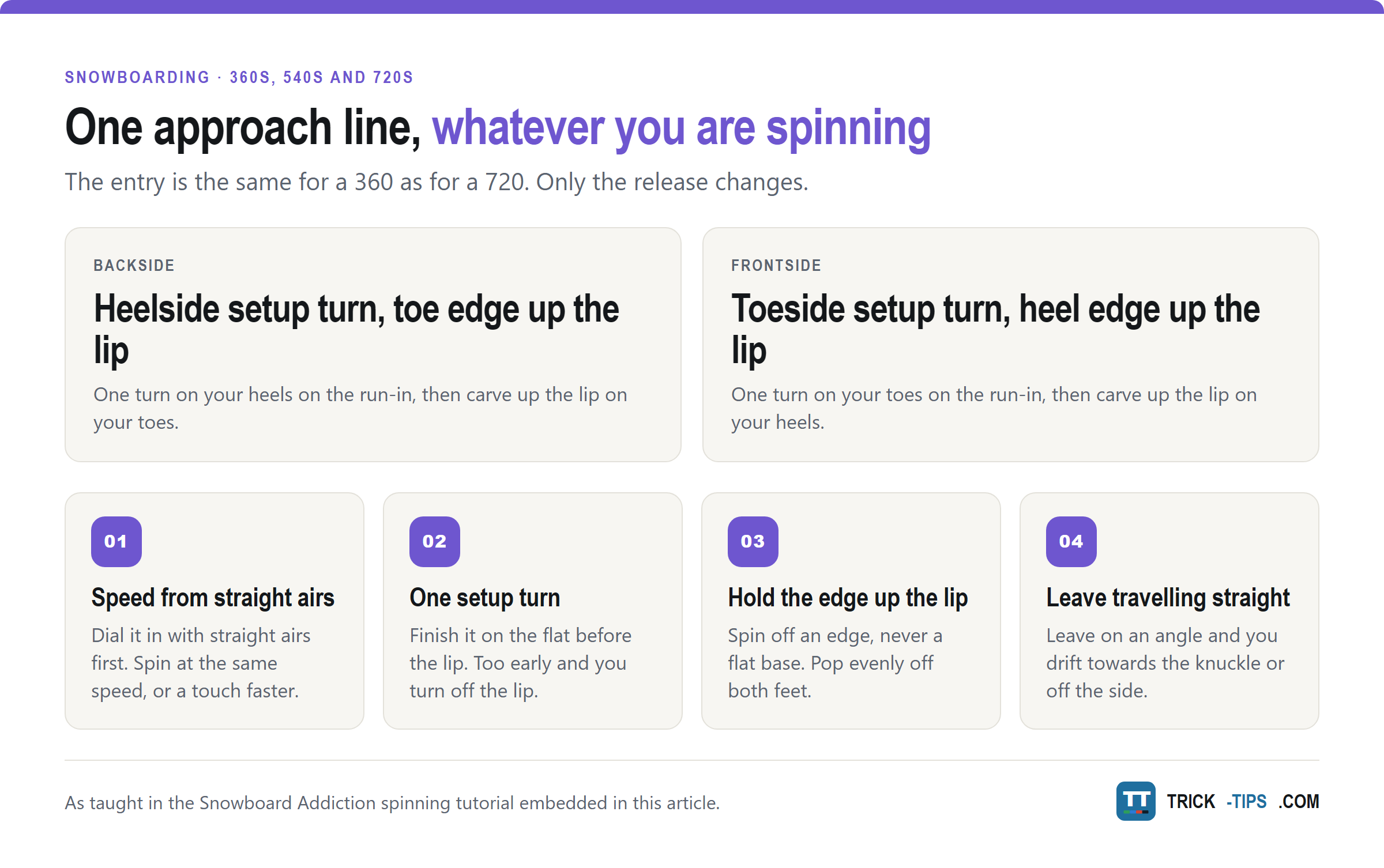
Here is the clever bit. You want to leave the lip on an edge, but you also want to leave it travelling straight. If you just carve up the lip on your toes, the board is still turning as it leaves, and you fly off in the direction it was turning.
So you make one setup turn on the other edge first.
- For a backside spin, drop in from your usual point, make one setup turn on your heel edge, then carve up the lip on your toe edge (5:13).
- For a frontside spin, make one setup turn on your toe edge, then carve up the lip on your heel edge (6:35).
Just one. At 5:37 he explains why. One setup turn lets you concentrate on what you are doing and where you are doing it. Lots of speed checks and extra turns throw off your balance and your focus.
At the very last moment, as you leave the lip, the board should be leaving in a straight direction (5:48). That sends you straight down the middle of the landing. Leave on an angle and you fly on that angle, which puts you on the knuckle or off the side (6:02).
The good news is in two parts. First, the line in is almost exactly the same for every amount of rotation (6:22 for backside, 7:06 for frontside), so a 360 and a 720 start the same way. Second, because you are carving rather than skidding, you lose very little speed (7:15), which is why a spin needs barely any more speed than a straight air.
Watch the lip of a big park jump and you will often see an hourglass shape carved into it (7:43). That is every good rider making the same platform.
The setup point
At 8:15 the video gets precise about where the setup turn happens.
The setup point is the flat bit between the downhill run-in and the uphill lip of the jump. That is roughly where you should be finishing your setup turn and moving onto the edge you will spin from (8:37). Then you hold that edge the whole way up the lip.
What happens if you set up too early? Your platform starts too early as well, so you are still turning as you leave the lip (9:04). Two things go wrong. You scrub off speed, and you drift off to the side of the landing. That is how people end up on the knuckle.
The release
This is where the size of the spin comes from, and it is not covered in the long video. Snowboard Addiction’s written guide to the same tutorial fills it in.
- Tall, small, tall. Stand tall on the approach, get small as you go through the setup point, then get tall again by extending your legs as you ride up the lip. That pop gives you a better trajectory and helps drive the momentum off your edge.
- Release your arms and shoulders into the spin. Their guide names three directions they can go, level around your body, diagonally down or diagonally up.
- More rotation needs more tension. A 360 on a small park jump takes a good wind-up. On a large jump the same 360 takes less, a 540 more, and a 720 considerably more.
Which is why the direction matters. Release diagonally by mistake and, in their words, you end up doing a corked spin. Not what you want on your first big one, so keep that release level while you learn.
The landing
Snowboard Addiction put up this short section from their frontside spinning tutorial, and it is the missing half of the long video. It is filmed for regular riders; there is a goofy version of the landing clip too.
At 0:10 it covers the basics. Absorb the impact by flexing your hips, knees and ankles. Then the two things that matter on any spin (0:19) are where you spot your landing and using an edge to stop your rotation once the board touches down.
Some spins give you an open landing, where you can see where you are going. Others give you a blind landing, where the landing comes into view late or you set down without seeing it.
| Spin | Landing | Edge to grip as you land |
|---|---|---|
| Frontside 180 | Open, never leaves your sight (0:29) | Heel or toe |
| Frontside 360 | Blind (0:45) | Toe edge (1:04) |
| Frontside 540 | Open, spotted after a full 360 (1:27) | Heel if slightly under, toe if slightly over (1:42) |
| Frontside 720 | Blind, spotted where the 540 is, then another 180 (1:51) | Toe edge (2:10) |
For backside, Snowboard Addiction’s written guide flips the pattern. A backside 360 has an open landing, a backside 540 lands blind, and a backside 720 lands open again.
If you do not grip with that edge, you revert. The board keeps rotating and slides round as you land (1:14). It is very common when learning front 3s and front 7s, and a toe edge grip is what kills the leftover spin.
And the one that saves you from the worst slams (2:35). On bigger spins you will come up short sometimes. Always land on your uphill edge, and you can usually slide the rest of the rotation out and ride away.
Common mistakes
Speed checks near the lip. Scrubbing speed at the last second is how you end up on the knuckle. Sort the speed out with straight airs, then commit to it.
Too many setup turns. One turn, then the platform. Every extra turn costs balance and concentration.
Setting up too early. The board is still turning as it leaves the lip, so you lose speed and drift towards the side of the landing.
Leaving the lip on an angle. You fly in the direction the board was pointing. Leave travelling straight.
Spinning off a flat base. No edge, nothing to push against, and the spin has to come from your arms.
Throwing your shoulders diagonally. It can tip a flat spin into an accidental cork.
Landing on a flat base. You revert and slide round. Grip with the right edge, and the uphill edge if you come up short.
Once the 360 is dialled
The approach does not change, so the progression is about the release and the landing.
Start your 360s on side hits, then take them to small park jumps once all four 180s are reliable there. When a 360 feels easy on a bigger jump, add more tension for the 540 and learn where to spot its landing. The 720 is the same line again with considerably more wind-up, and another blind landing to learn.
Link spins onto features and you are into combos like a backside 180 on to a switch 50-50, switch frontside 360 out. And if you have not got your rails going yet, the frontside boardslide and backside boardslide are waiting.
Safety
Spins go wrong sideways and backwards, and a 540 or 720 goes wrong at the speed of a proper park jump. Wear a helmet.
Know the jump before you spin it. Hit it with straight airs until you are clearing the knuckle every time, and look at the landing before you drop in, because on a big jump you cannot see it from the top. Wait for a clear landing, every time.
Size up in steps. A 360 that comes up short on a side hit is a slide on your backside. The same mistake off a big park jump is a very different fall.
If you are taking spins to large park jumps, a session with a qualified freestyle coach is worth far more than any video, this one included.
Frequently Asked Questions
How do you do a 360 on a snowboard?
Carve up the lip on the edge you are spinning from after one setup turn on the other edge, leave the lip travelling straight, pop evenly off both feet and release your shoulders into the spin. Spot the landing and grip with the right edge as you touch down. Learn it on side hits first, once all four 180s are solid on small park jumps.
Is a frontside or backside 360 easier?
Most people learn frontside first, off the heel edge. Snowboard Addiction point out that you can see the landing of a frontside 360 pretty much the whole time you are in the air, which is part of why it is one of the most common tricks. Backside is almost always spun off the toe edge.
Do you need more speed to spin than to straight air?
Barely. Snowboard Addiction’s advice is to use the same speed as your straight airs, or a tiny bit faster. Because you carve your setup turn and platform rather than skidding, you lose very little speed on the way to the lip.
Why do I keep landing on the knuckle when I spin?
Usually one of three things. You are checking speed too close to the lip, you are setting up too early so the board is still turning as it leaves, or you are leaving the lip on an angle. All three send you short or off to the side. Fix the approach and the landing sorts itself out.
Why do I slide out or keep rotating when I land a 360?
That is a revert. You landed on a flat base and nothing stopped the rotation. Grip the snow with an edge as you land, the toe edge on a frontside 360, and it kills the leftover spin.
What is the difference between a 540 and a 720 on a snowboard?
An extra half rotation and a different landing. The approach is the same for both, but a 720 needs considerably more tension at the release. On a frontside 540 you spot an open landing after a full 360; a frontside 720 spots in the same place, keeps turning another 180 and lands blind.
In short
A 360, 540 and 720 all start the same way. One setup turn, a solid platform up the lip on the edge you are spinning from, and the board leaving the lip straight. Speed from your straight airs, a bigger release for a bigger spin, and grip with the right edge when you land.
Next session, forget rotating. Ride your usual line at your straight air speed, make one setup turn finished on the flat before the lip, and check the board is leaving straight. Once that feels automatic, the spins come.
Ask any questions in the comments below.