You are standing in a shop looking at a wall of forty pairs, half of them bent into banana shapes, and the labels say things like “aggressive downturn” and “high performance”. None of that tells you which one to buy.
Here is the short answer, and it is not the one the shop wall implies. Fit comes first, and nothing else is close. A well fitting beginner shoe will do more for your climbing than a badly fitting expert shoe. Once a shoe actually fits your foot, then you can start thinking about whether you want it soft or stiff, downturned or flat, velcro or laces, and those choices follow from where you climb rather than from how good you are.
Most of what you have been told about “earning” aggressive shoes is marketing and gym folklore. This guide takes it apart.
Watch it first
The pick is Lattice Training’s shoe guide, and the reason is partly what it says and partly what it does not do. At 1:18 the presenter stops to say that the brand whose shoes he is holding is not paying for the video, and that the demo pairs were lent by a local shop. That matters here more than in most topics, because the most watched climbing shoe videos on YouTube are sponsored, and a sponsored video cannot tell you that the shoe in its hands is the wrong shape for your foot.
It is about 15 minutes and it is chaptered. The overview runs from 0:27, indoor shoes from 1:48, softness and stiffness from 2:42, closure systems and toe rubber from 4:04, and the low volume question from 9:13. The sentence the whole guide turns on is at 8:10, and the myth busting starts at 10:04.
The four things that actually vary
Strip the marketing off and a climbing shoe varies in four ways. The video takes these from Lattice’s earlier shoe video and then shows what each one does on the wall.
- Fit. How well it matches the shape of your foot. This is the one that decides everything else.
- Shape. How downturned the toe is, and how asymmetric, meaning how far it bows in towards your big toe.
- Stiffness. Partly the rubber at the toe, partly the midsole. A stiff midsole holds tension out to the tip of the shoe; a soft one lets the shoe fold and mould.
- Closure. Laces, velcro, or slip-on.
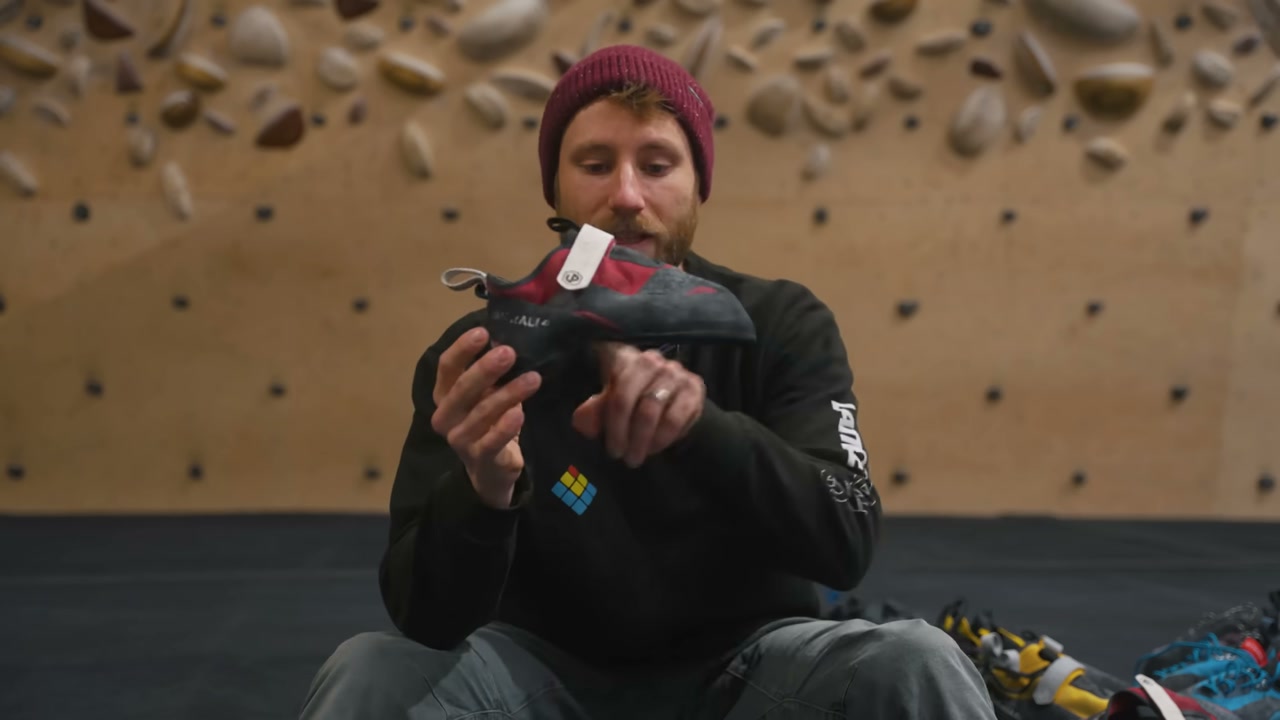
Where you climb decides the shape, not how good you are
The useful question is not “am I a beginner?” It is “what am I standing on?”
| Where you climb | What you are standing on | What tends to suit it |
|---|---|---|
| Indoors, and competition-style setting | Big holds and volumes, lots of smearing, and you can often use the wall itself | Softer, so it moulds and smears. Often downturned and asymmetric, with plenty of toe rubber for toe hooks |
| Outdoors, on small edges | Tiny footholds where all the pressure goes through one small point at the front | Stiffer, so the shoe holds tension out to the toe instead of folding |
| Outdoors on sandstone, Fontainebleau style | Rounded features and far more smearing than edging | Soft, despite being outdoors. The rule follows the rock, not the postcode |
| A bit of everything | All of the above | An all-rounder: less downturned, less asymmetric, moderate stiffness |
Table: What the ground under your feet suggests, from the Lattice Training guide.
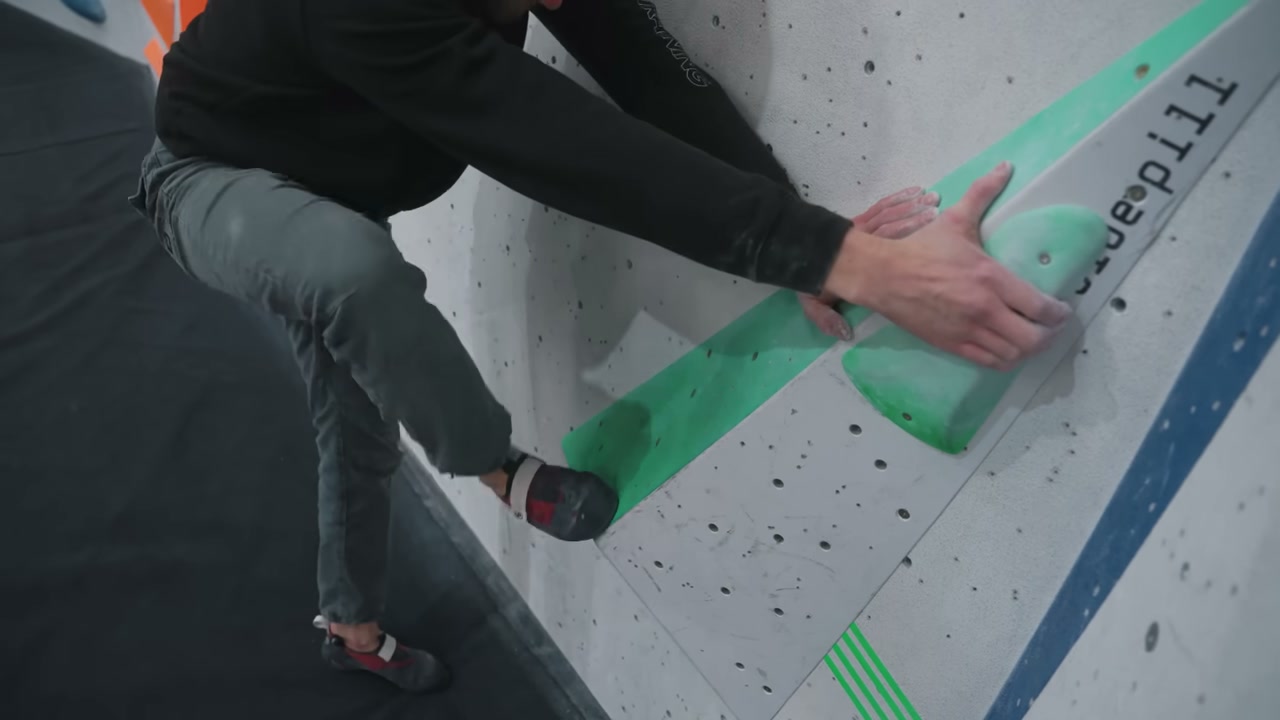
Laces, velcro or slip-on
This is a real trade and it is worth understanding before you decide it does not matter.
Slip-ons and single-strap velcro put more rubber over the top of the toe, which makes them better for toe hooking. They also come on and off in a second, which is worth more than it sounds indoors: taking your shoes off between bouldering attempts is a good way to make yourself rest properly, and the presenter recommends exactly that.
Lace-ups let you tune the fit along the whole length of the shoe. The presenter climbs in laces because he can get the heel really tight, and heel hooking is his strength. If your feet are an awkward shape, or you have struggled to find anything that fits, laces are usually where you find it.
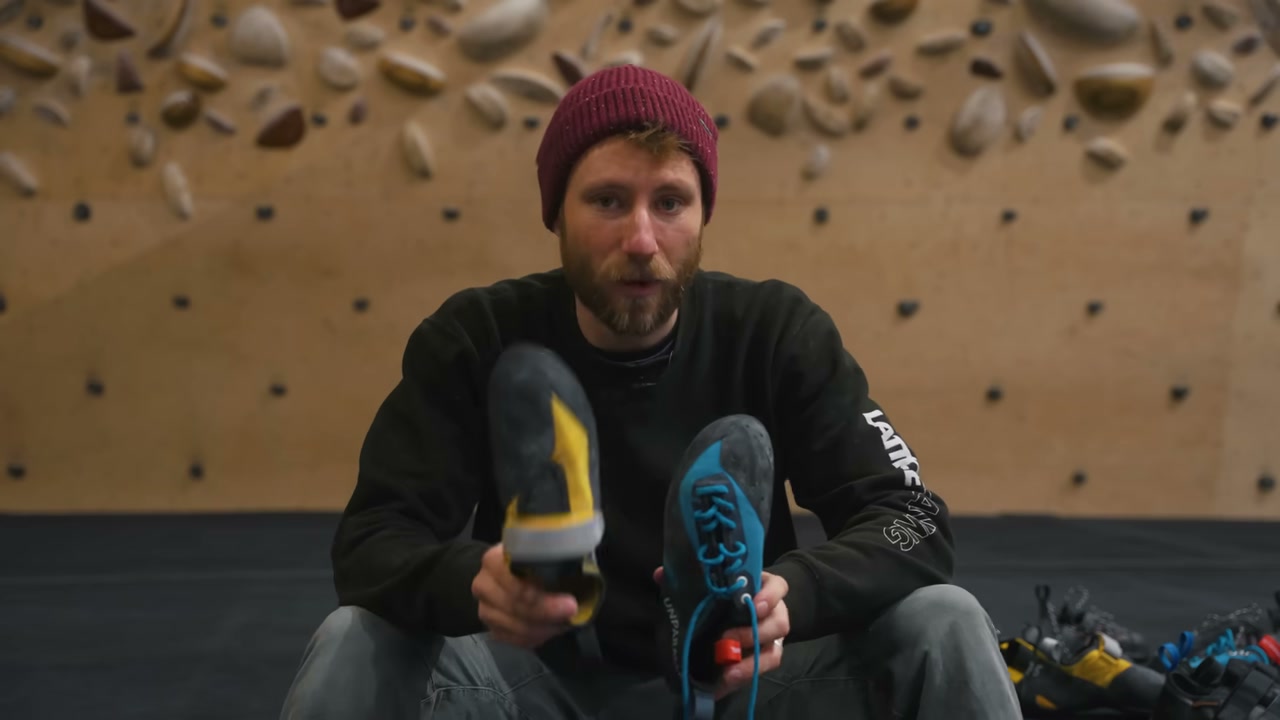
And no, lace-ups are not useless for bouldering. That is one of the myths below.
Fit, and how tight is too tight
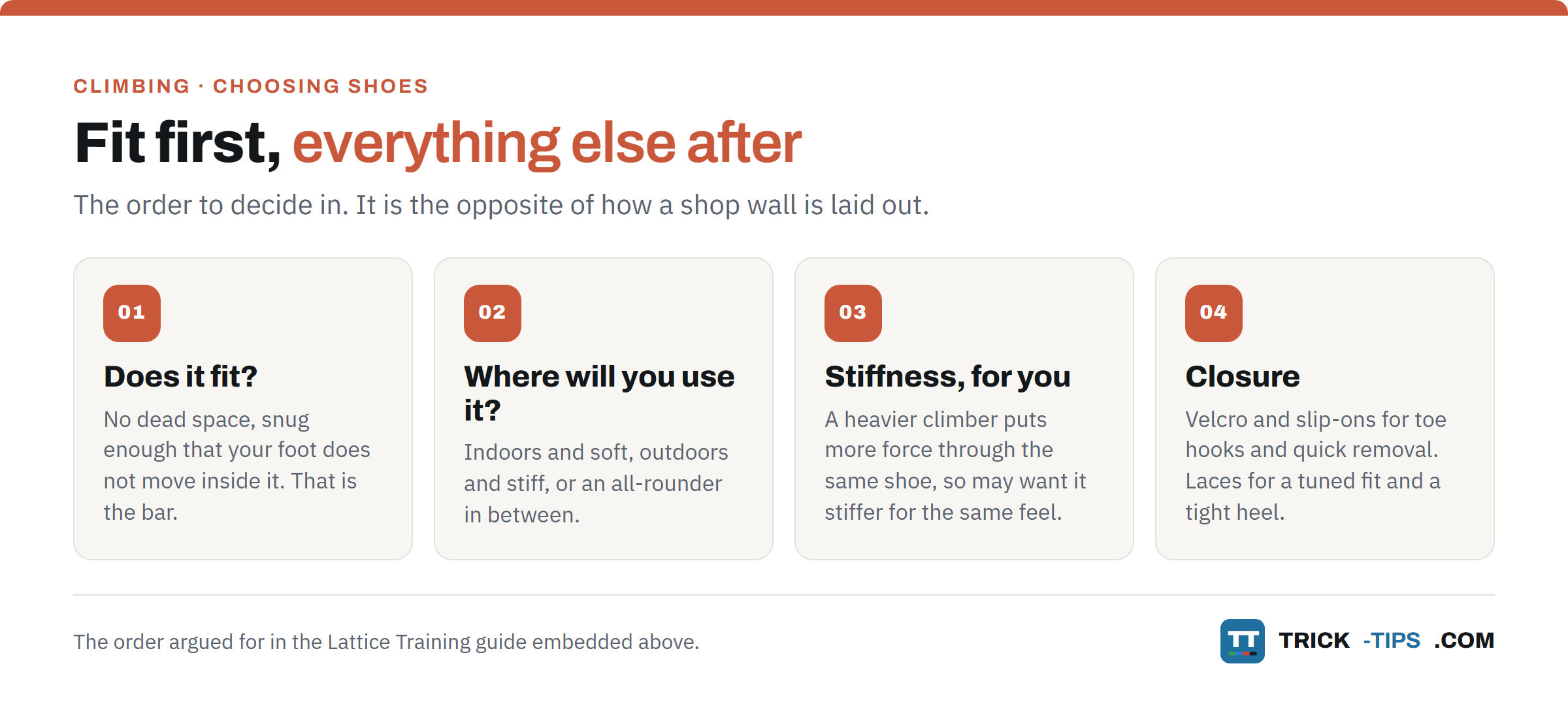
Here is the hierarchy the video argues for, and it is the opposite of how shops are laid out.
- Does it fit your foot? No dead space, snug enough that your foot does not move inside it. That is the bar.
- Where will you use it? Indoors and soft, outdoors and stiff, or something in between.
- Stiffness, adjusted for you. A heavier or taller climber puts more force through the same shoe, so may want it stiffer to get the same feel a lighter climber gets from a softer one.
- Closure, according to whether you care more about toe hooks or heel hooks.
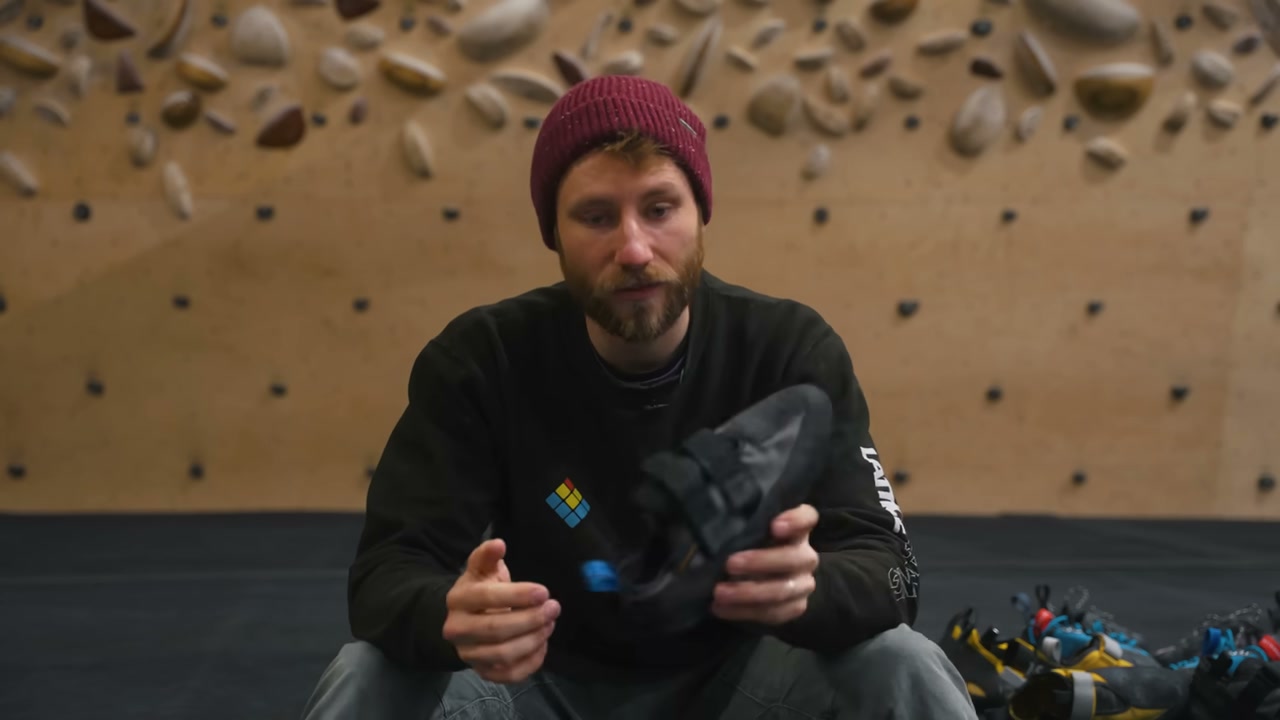
On pain. Climbing shoes should be snug. They should not make you cry. The video’s line at 13:26 is blunt and worth repeating: if you are in tears by the end of a session, the shoe is too tight and you should size up. Too tight actively costs you performance, because once your toes have gone numb you have lost the sensitivity that lets you feel what your foot is doing. Modern shoes are built to apply tension through the rand for you, so you do not need to force it with three sizes down.
Low volume versions. Many brands now sell the same model in a low volume fit, which suits a narrower foot. Worth trying both. Be aware that on some brands the low volume version also uses a thinner or softer rubber, so you may be changing the stiffness at the same time as the width. Check the specification rather than assuming.
Four myths worth dropping
“Downturned shoes are for advanced climbers.” No. A downturned shoe is useful for particular kinds of climbing, not a reward for reaching a grade. The video points at Steve McClure, who climbed 9b in a shoe that was almost flat.
“You need a separate training shoe.” There is a decent argument the other way: train in the shoe you intend to perform in, so you know the tool. If you do want something comfier for high-mileage sessions, the video’s tactic is better than buying a second pair. Keep your old shoes when they go baggy but still have rubber, and train in those.
“Climbing shoes are supposed to hurt.” Snug, yes. Painful, no. See above.
“Lace-ups are no good for bouldering.” Not true. You give up a little toe rubber and you gain a heel you can really tighten, which matters because bouldering is full of heel hooks.
Beyond the video
A few things the video does not cover.
- Buy them in a shop, and stand on something. Most climbing shops have a small wall or a board by the fitting area, and UK retailers recommend using it. A shoe that feels fine standing flat on carpet tells you very little, because you are not going to be standing flat on carpet. Get on a foothold and see whether your heel lifts and whether the toe holds.
- Resoling is usually cheaper than replacing, and it is what makes the “keep your old pair” tactic work. If the uppers are still sound and only the rubber has gone, it is worth pricing a resole before buying new.
Where this sits in the gear guide
- Understanding forces is the one to read first if you are new to the series.
- Ropes, belay devices, slings and webbing and protection are the rest of the kit.
- Flagging is where to go once you have shoes, because footwork is what makes them worth anything.
Frequently Asked Questions
How should climbing shoes fit?
Snug, with no dead space for your foot to move inside. They should not be painful. If you are in real discomfort by the end of a session, the shoe is too small and you should size up.
What size climbing shoes should I buy?
There is no reliable number of sizes to go down from your street shoe size, because shoe brands and foot shapes vary too much. Try pairs on and judge by whether the shoe matches the shape of your foot with no gaps, not by the number on the label.
Should beginners buy downturned climbing shoes?
Downturn is not a difficulty level. It suits steep climbing and toe hooking. A flatter shoe is more comfortable and perfectly capable, and the video points out that people have climbed 9b in one.
Are lace-up or velcro climbing shoes better?
Neither. Velcro and slip-ons give you more toe rubber for toe hooking and come off quickly between attempts. Laces let you tune the fit, especially around the heel. Pick for the fit you get and the hooks you use.
Do I need a separate training shoe?
Not really. There is a good case for training in the shoe you want to perform in. If you want something comfortable for long sessions, keep your old pair once they go baggy rather than buying a second pair.
Should my first climbing shoes be expensive?
No. Fit beats everything, so a cheaper shoe that matches your foot will serve you better than an expensive one that does not. Spend the money once you know what shape suits you.
In short
Ignore the beginner-to-expert ladder on the shop wall. Find the shoe that matches the shape of your foot with no gaps and no agony, then pick softness and shape from where you actually climb, and closure from whether you hook more with your toes or your heels.
If you are buying your first pair, try on everything in your size range, walk around in them, and buy the one that fits rather than the one that looks fast.
Ask any questions in the comments below.