Walk into a snowboard shop for the first time and the wall of boards can feel like a test you did not revise for.
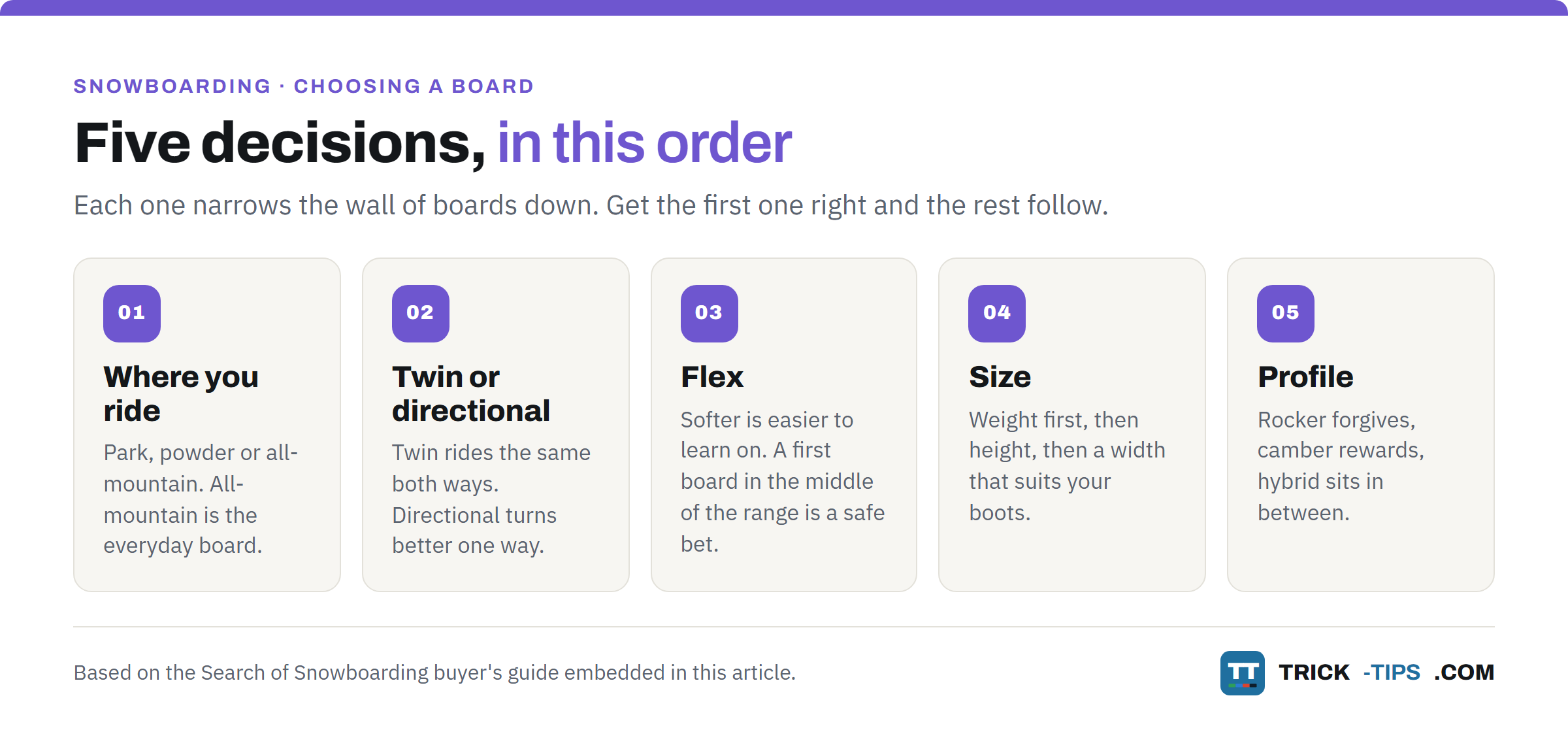
Here is the short answer on how to choose a snowboard. Work through five decisions in order. Where you will ride it (park, powder or all-mountain), twin or directional, how stiff, what size (weight first, then height, then a width that suits your boots) and what profile (rocker, camber or a hybrid of the two). For most people buying a first board, that lands on an all-mountain board with a medium flex, sized by weight rather than height, and wide enough that your boots do not drag.
Each of those has a reason behind it, and once you know the reasons the wall stops being scary. We have picked a video that walks through all five, and what follows is the breakdown with timestamps.
Why this video
This is the third time Search of Snowboarding has won a vetting round here, after the bindings setup article and the boots guide. The reasons are the same each time. Shane Serrano explains why each choice matters, he gives you rules you can use rather than one right answer, and he is honest about where the rules bend.
It is worth knowing up front that this is a shop video. Shane works at Radio Boardshop in Aspen, and he mentions the shop’s website near the end (10:15). What earned it the spot anyway is the order he says it in. He tells you to go to your local shop first, and only mentions his own for people who have not got one. The discount codes in the video description are for outerwear and other kit, none of them for boards.
Of the six videos we looked at, it is the only one that covers every decision a first buyer faces, in the order a good shop conversation goes. It is eleven and a half minutes, and it is chaptered.
If you want to skip around, shape is at 0:49, riding styles at 2:01, flex at 5:13, sizing at 7:06 and camber profiles at 10:32. He names a few specific boards as examples along the way. Models change every season, so we have left the names out and kept the reasons.
How to choose a snowboard in five decisions
Notice that size comes fourth, not first. In the video, the first thing you need to know is what kind of riding the board is for, and everything else follows from that.
Where will you actually ride it?
This is the first real decision, and the video is clear that it is the one everything else hangs off (0:19). Some boards ride everywhere well. Others are built for one kind of terrain. So it pays to be honest about where you will spend most of your days.
First, twin or directional?
Before the styles, the video sorts out shape (0:45), because it comes up in every one of them.
A twin board has a nose and tail that are the same. Ride it forwards or backwards and it reacts the same way.
A directional board is not symmetrical. It usually has a longer nose than tail, plus other differences in how it is built.
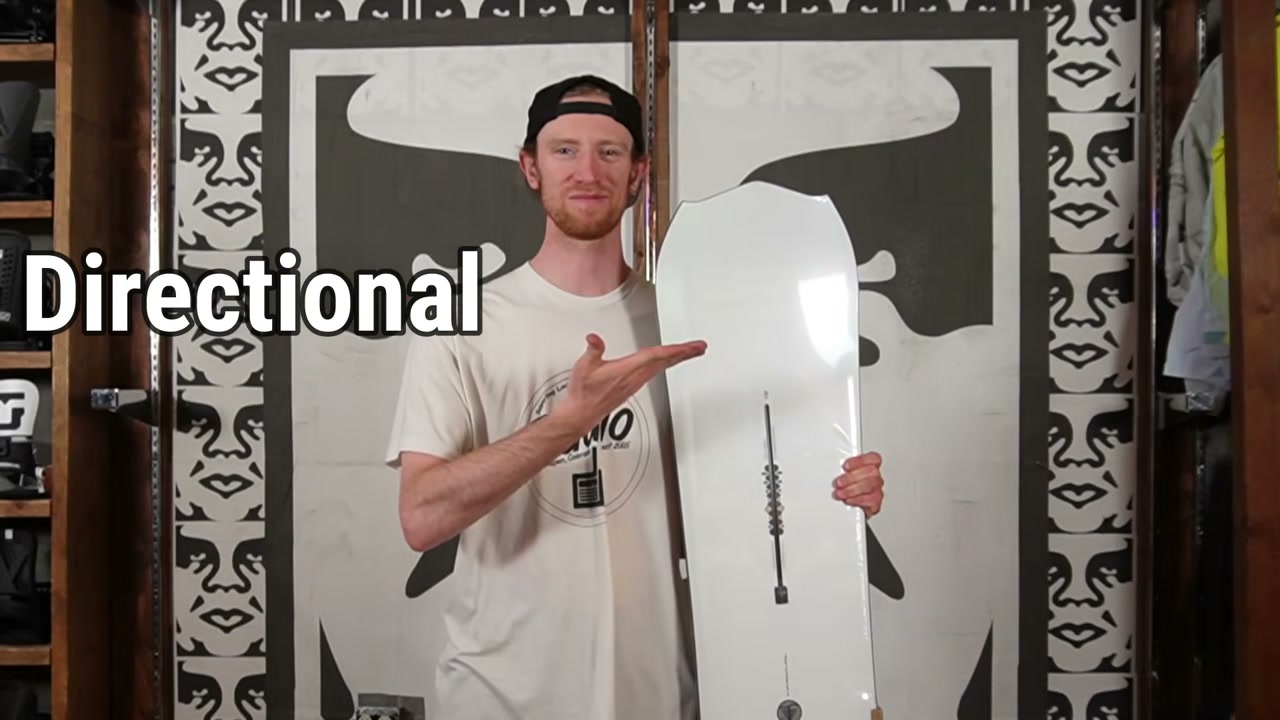
Here is the bit that puts a lot of people off directional boards for no good reason. They hear “directional” and assume it means they can never ride switch (backwards). As the video points out at 1:12, that is wrong. You can ride most directional boards switch without any problem. The easiest way to think about it, he says, is that a directional board turns better in its one direction than a twin does in either.
You will also see directional twins, which can mean a few different things, such as a twin shape with a stance set slightly back. Do not let the label throw you. They ride well in whatever terrain the board was designed for.
The three riding styles
Brands use a lot of names, but at 2:01 the video boils them down to three.
| Style | Usually | What it does well | What you give up | In the video |
|---|---|---|---|---|
| Powder (or freeride) | Wider, directional, sometimes a swallow tail | Floats in deep snow, and carves well on the piste too | Not one for the terrain park | 2:03 |
| Park (or freestyle) | Twin | Spinning, landing switch, taking off switch | Less float than a powder board, less carve than all-mountain | 3:04 |
| All-mountain | Twin or directional | Almost everything: piste, trees, bumps, powder, jumps | It is a jack of all trades by design | 3:35 |
A couple of points from that section are worth pulling out.
A powder board does not lock you into powder. The video makes the point at 2:48 that their shape lets them ride the piste and carve really well, so they are still good fun on a day with no fresh snow.
All-mountain boards are the “daily driver”. If you are not going into the park, the video’s suggestion at 4:00 is to look at a directional all-mountain board, because it makes turning and carving more fun.
You will also see blends. An all-mountain freestyle board is built for someone who rides the whole mountain but likes to throw tricks (4:21). An all-mountain freeride board is for someone who rides the resort but also likes charging in powder (4:42).
Pick one of those three and you have ruled out a big chunk of the wall straight away.
How stiff should your first snowboard be?
Flex is next (5:13). There are two kinds. Longitudinal flex runs from nose to tail, and that is the one you will mostly be checking in a shop. Torsional flex runs from edge to edge, and the video describes it as the flex that lets you steer the board with your feet (6:13).
The rule of thumb at 5:19 is simple. A softer board is easier to control and more forgiving, which makes it easier to learn on. A stiffer board takes more energy to bend and gives more back, with more snap and power at speed, which is why it suits more advanced riders.
Once you have ridden a few boards, flex becomes personal. The video points out at 6:29 that you will see good riders on soft boards because they are easy to butter and press on rails and boxes, and others who only ride stiff boards because they ride flat out everywhere.
For one of your first boards, the video’s suggestion at 6:41 is a flex right in the middle of the range. That gives you enough stability at speed with enough give to be easy to ride.
How to flex a board in a shop
This is a lovely practical bit, at 5:47.
- Wrap your arm under the nose of the board.
- Press firmly through the middle with your other hand. Do not be shy about it. As the video says, you will not break it.
- Check the whole board is bending, not just the tail.
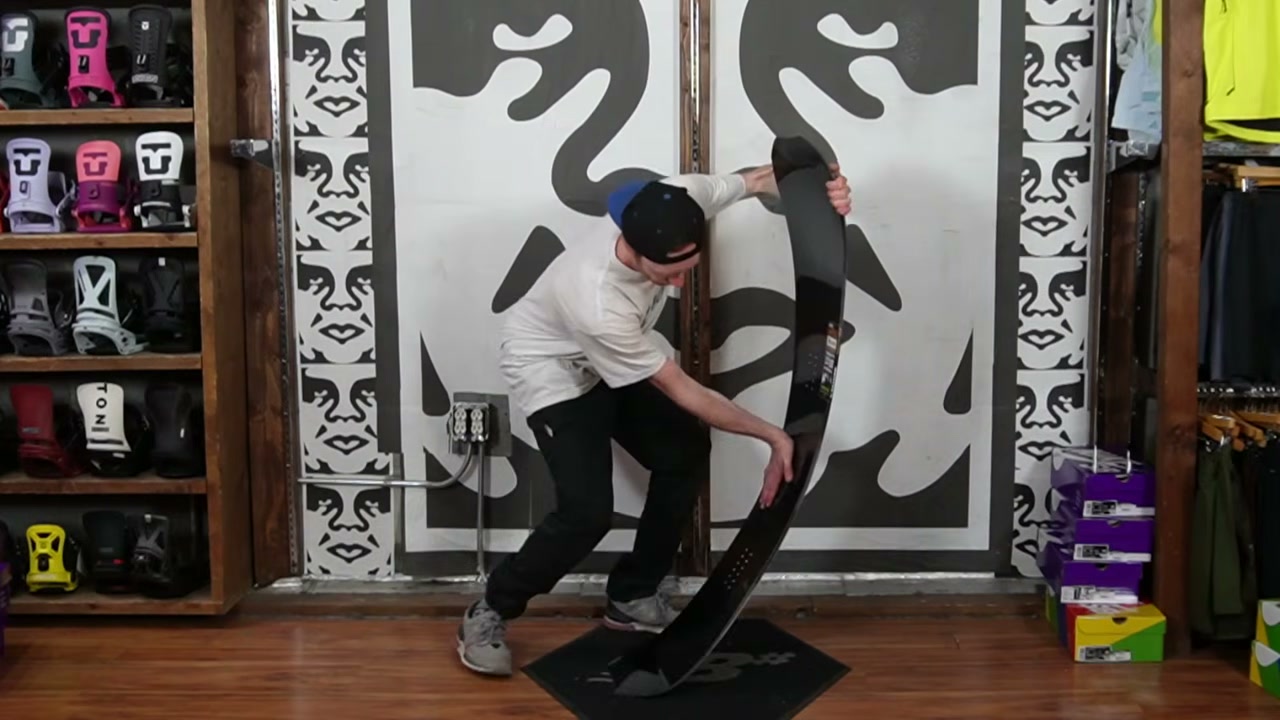
What the video tells you not to do (6:03) is put your knee into it or use one hand. That does not show you much difference between boards, and in Shane’s words it makes you look like you do not know what you are doing.
What size snowboard do you need?
Sizing gets more time than anything else in the video (7:06). Three things decide it: your weight, your height and your boot size.
Weight matters most
Weight is the most important of the three (7:10). His way of putting it is that a snowboard knows how much you weigh, but it does not know how tall you are. He is six foot and lighter than most people his height, so he may ride a slightly smaller board than the average six-footer.
Look on a board’s spec sheet for the rider weight column (7:26). The weight ranges overlap between sizes, and the advice is to aim to sit roughly in the middle of a size’s range.
There is no one perfect size
This is the most useful thing in the whole video, at 7:44. Your boot size is your boot size, but you have some leeway with a board.
If you are torn between two sizes, the video’s rule at 7:53 is this.
| If you want… | Go… | What you get |
|---|---|---|
| A board that holds up better at speed | The bigger size | More power and stability |
| A board that is easier to throw around | The smaller size | More nimble, easier to manoeuvre |
Then check it against your height
Stand the board on its tail next to you. The video says it should come up somewhere between just below your chin and your top lip (8:08). But weight still wins, so check the board’s size chart as well.
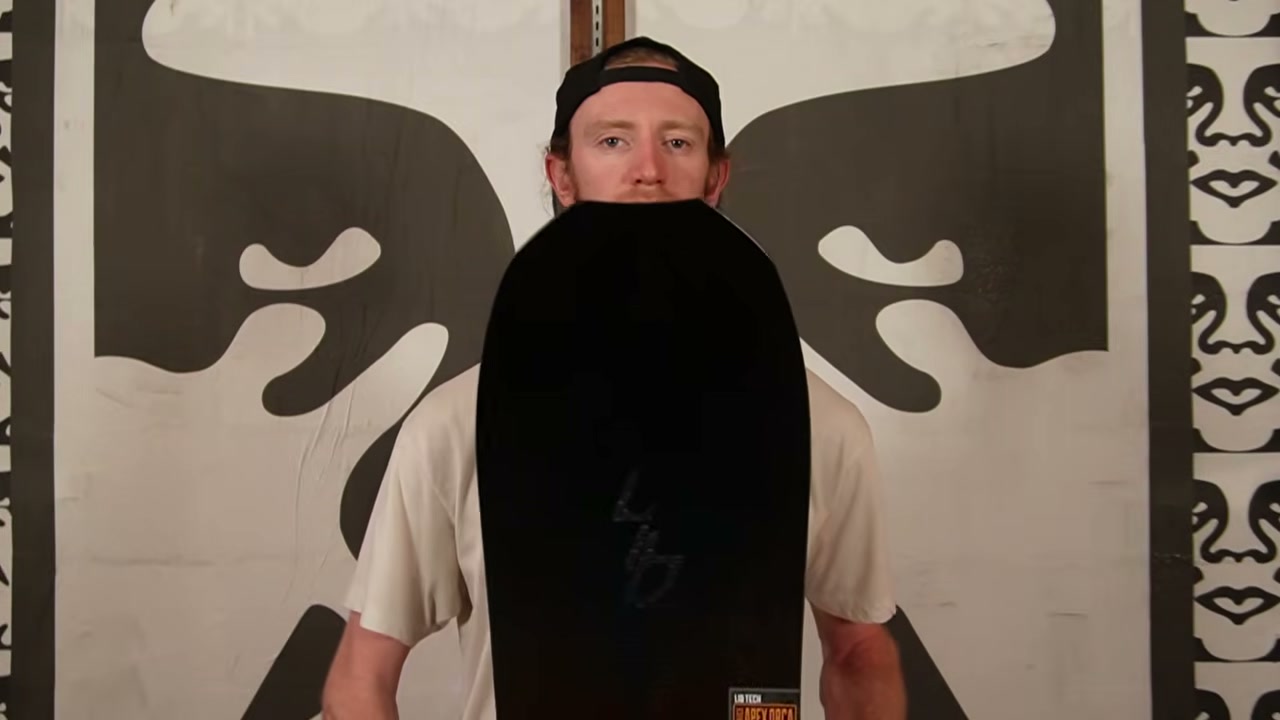
Width: the one people forget
The last part of sizing is width, and the video calls it key (8:20). If a board is too narrow for your boots, your toes and heels drag in the snow when you lean into a deep turn. As the video says, that is not something you want.
Do not panic if you put your boot across the board and see a bit of overhang (8:35). Most boots will overhang a little, and once your bindings lift the boot up it should not be a problem. It is too much overhang you are looking for.
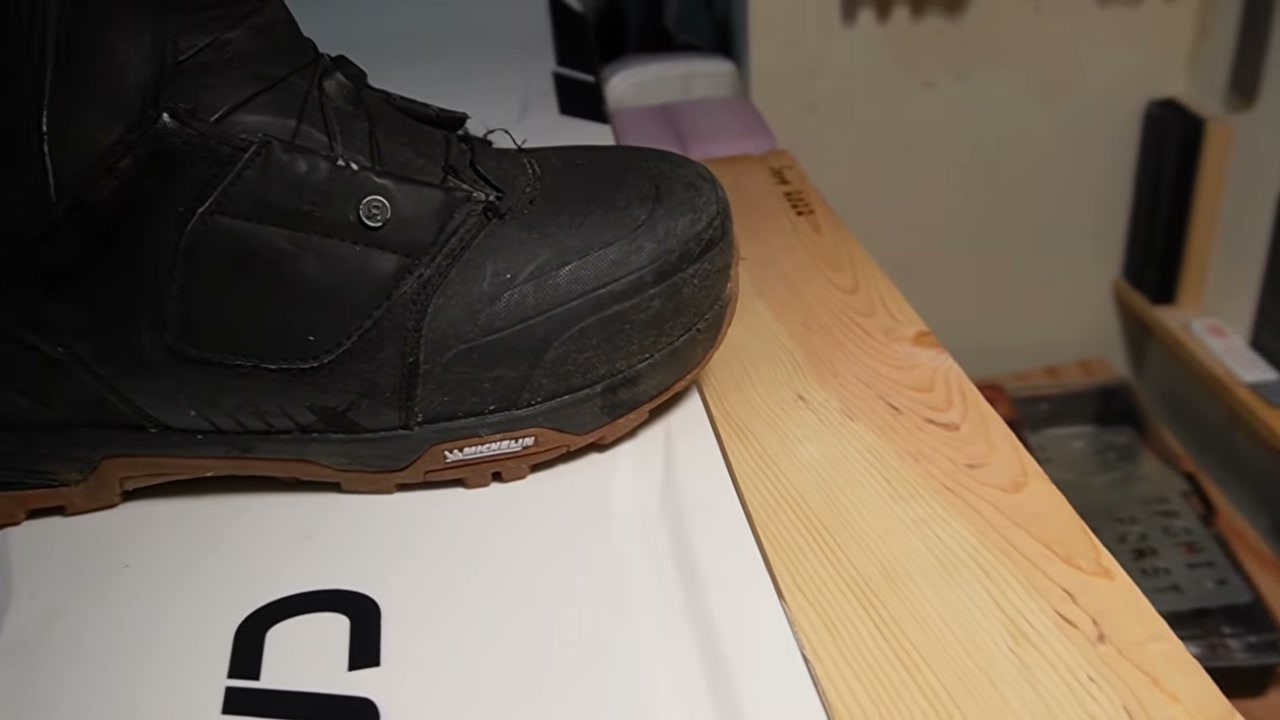
Board widths differ by millimetres, which is hard to judge. So the video gives you one simple rule at 8:53. If your boots are a US 10.5 or bigger, look at wide boards. Those are US men’s sizes, which on most brands’ charts is about a UK 9.5 or a European 44. Wide boards are usually marked with a W after the length (9:02).
Specialty boards
You will also come across boards that ignore all of this (9:04). Some are made to be ridden extra long. Others are volume shifted, which means the brand has taken length out of the board and put it into the width, so you ride a much shorter board than usual.
The video’s advice for a first board at 9:45 is to leave the extra-long ones alone, but not to be afraid of volume-shifted boards. He says some of them are fun even for beginners.
Camber, rocker or hybrid?
The last piece is the profile, which is the shape of the board when you look at it from the side (10:32). The video only gives it a short section, but it is clear that it is one of the most important choices of all, because it changes the ride so much.
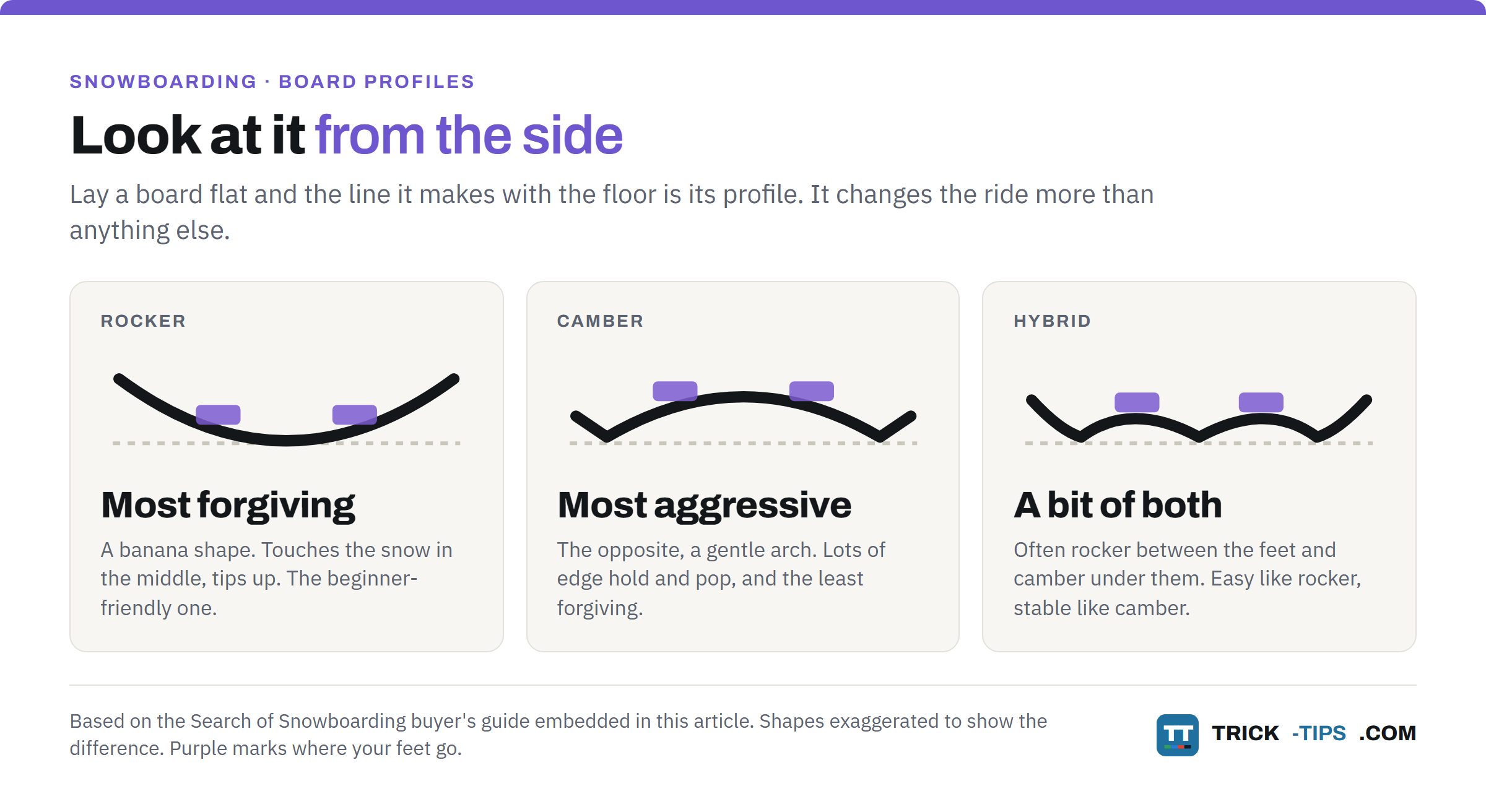
Rocker (or reverse camber) curves up at both ends like a banana. The video calls it the most forgiving and beginner-friendly profile (10:38).
Camber is the opposite, a gentle arch in the middle. It gives the most aggressive ride and is the least forgiving (10:44).
Hybrid mixes the two. The common version the video describes at 10:55 has rocker between your feet and camber under them, which gives you the ease of rocker with the stability of camber.
If you want more on profiles, the ALL aBOARD guide to bend, shape and flex is the best we found on this part. It covers camber at 2:35, rocker at 3:29, flat profiles at 3:55 and the hybrids from 4:30. It adds two useful points. Camber gives you a lot of pop and edge hold, and pure rocker boards do not hold an edge as well, which is why most rocker you see now comes as part of a hybrid. Its example boards at the end are all from one brand, so treat those as examples rather than recommendations.
| Profile | From the side | The ride | Who it suits |
|---|---|---|---|
| Rocker | Banana, tips up | Most forgiving, easiest to turn | Beginners, according to the video |
| Camber | Arched in the middle | Most aggressive, least forgiving, lots of pop | Stronger riders who want edge hold |
| Hybrid | Usually rocker between the feet, camber under them | Easy like rocker, stable like camber | A wide range of riders |
| Flat | Flat, with the tips lifted | Stable, and easy to start a turn | Covered in the ALL aBOARD video, not this one |
Common mistakes when buying a board
Sizing by height alone. The old “stand it up and see where it comes to” check is a second check. Weight comes first, and the board’s own size chart is where you find it.
Writing off directional boards. If you want to ride switch, a directional board does not stop you. Most ride backwards fine.
Buying the stiffest board you can afford. Stiff is not the same as better. It takes more energy to bend, and a first board is easier to learn on somewhere in the middle.
Forgetting your boots. A board that is too narrow for your boots will drag your toes and heels in a deep turn. If you take a US 10.5 or bigger, start with the wide models.
Testing flex with your knee. Arm under the nose, press through the middle, both hands. Otherwise you learn nothing about the board.
Beyond the video
One thing the video does not say outright, and which is worth adding.
If you are a beginner, aim for the shorter end of your size range. The video already tells you that a smaller size is more nimble and easier to manoeuvre. Size guides from evo and OnTheSnow both go a step further and recommend that beginners pick the shorter end of the range their weight and height give them, because a shorter board is easier to control while you are learning to turn and stop.
Where this sits in your setup
Boots come first, because the width of your board depends on them. So if you have not got boots yet, start with how to choose snowboard boots, then come back to the board.
Once the board is home, set up your bindings and give it a wax. Then it is out on the snow for your first turns.
Frequently Asked Questions
What snowboard should a beginner buy?
For most beginners, an all-mountain board with a flex in the middle of the range is the safe choice. Size it by your weight first using the board’s size chart, and check your boots will not hang too far over the edges. A rocker or hybrid profile is more forgiving to learn on than full camber.
What size snowboard do I need?
Start with your weight, which matters more than your height. Find the rider weight column on the board’s spec sheet and pick the size whose range you sit in the middle of. Then check it against your height. Stood on its tail, the board should come up somewhere between just below your chin and your top lip.
Should I get a longer or shorter snowboard?
If you are between two sizes, go longer for more stability at speed and shorter for a board that is more nimble and easier to manoeuvre. Size guides also recommend beginners aim for the shorter end of their range, because a shorter board is easier to control while learning.
Do I need a wide snowboard?
If your boots are a US men’s 10.5 or bigger, about a UK 9.5 on most charts, look at wide boards, usually marked with a W after the length. A board that is too narrow lets your toes and heels drag in the snow on a deep turn. A little boot overhang is normal, and it is a lot that causes trouble.
Is a twin or directional snowboard better?
Neither is better, they do different jobs. A twin rides the same in both directions, which suits park riding and switch tricks. A directional board turns better in its one direction, and you can still ride most of them switch without any problem.
Is camber or rocker better for beginners?
Rocker is the most forgiving and beginner-friendly profile. Camber gives the most aggressive ride and is the least forgiving. A hybrid, which usually has rocker between the feet and camber under them, gives you some of each and suits a wide range of riders.
In short
Decide where you will ride first, and the rest follows. Then pick twin or directional, go middle of the road on flex for a first board, size by weight before height, make sure the board is wide enough for your boots, and choose a profile that forgives you while you learn.
There is no single perfect board for you, and the video is refreshingly honest about that. What there is, is a set of decisions you can now make yourself, in a shop or on a laptop.
If you can, go to your local shop before the season starts and flex a few boards with both hands. Then come back and tell us what you ended up on.
Ask any questions in the comments below.