Maybe the bit that worries you is not falling over. It is being the person who causes a crash, or getting shouted at by someone flying past who seems to know rules nobody ever told you.
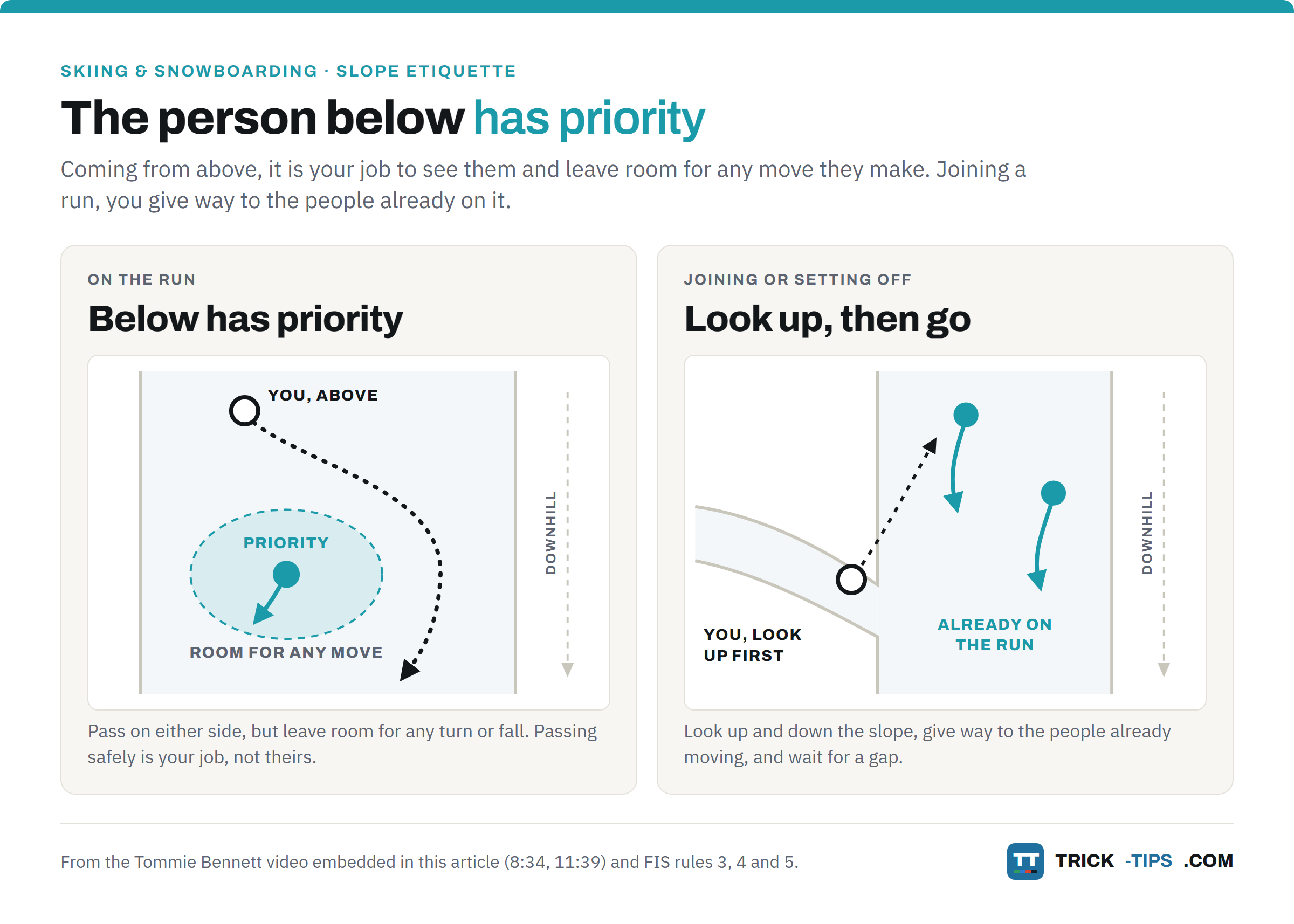
Here is ski slope etiquette in short. The person below you on the slope has priority, and it is your job to avoid them. Stop at the side of the piste, somewhere people coming down can see you from a long way off, and never just below a bump or in a narrow bit. Look up the hill before you set off or join a run. And if someone gets hurt, you stop and help.
That is most of the international code for skiers and snowboarders, the FIS rules, and it is the same code for both. Ski areas from Scotland to the Alps publish it. Below are all ten rules in one table, then the situations where they matter most.
Watch it first
The pick is Tommie Bennett, who introduces himself as a snowboard coach (0:38). Most of the alternatives are one to three minute resort safety clips about the code. This one goes and stands in the situations, so you see a roller from above and then from below, a staged near miss, and what joining a busy run looks like.
It covers skiers and snowboarders together. It is long at 16 minutes and chatty, so the timestamps below get you straight to the useful bits. It was filmed in the US (he mentions Keystone at 4:15), so you will hear “right of way”, “trail” and distances in yards, but on every point it covers, the rules are the same as the international ones.
One heads-up. The video carries a short sponsor read for a wax brand with a discount code (2:43), and plugs for the channel’s own stickers and merch (7:41, 14:28). The description adds an outerwear affiliate link and his own paid snowboard course. None of it has anything to do with the etiquette.
The chairlift is at 1:07, strapping in out of the way at 2:01, where to stop at 3:59, blind spots at 5:29, who has priority at 8:34, joining a run at 11:39, signalling your turns at 13:46 and the lift queue at 14:38.
The ten rules of ski slope etiquette
The international code is the FIS Rules for the Conduct of Skiers and Snowboarders, from the International Ski Federation. There are ten. Here they are in plain English, and you can read the official wording from FIS too.
| # | FIS rule | What it means on the piste |
|---|---|---|
| 1 | Respect for others | Ski or ride in a way that does not put anyone else at risk. |
| 2 | Control of speed | Stay in control. Match your speed to your ability, the terrain, the snow, the weather and how busy it is. |
| 3 | Choice of route | Coming from behind, you choose a line that does not endanger the people ahead. They have priority. |
| 4 | Overtaking | Pass on either side, above or below, but leave enough room for any move they make, on purpose or not. |
| 5 | Entering, starting and moving upwards | Look up and down the slope before you join a run, set off again after stopping, or head back up the hill. |
| 6 | Stopping | Unless you have to, do not stop in narrow places or where people cannot see you. If you fall there, get clear as soon as you can. |
| 7 | Climbing and descending on foot | Walking up or down? Keep to the side of the piste. |
| 8 | Signs and markings | Respect every sign and marking, closures included. |
| 9 | Assistance | At an accident, you are duty bound to help. |
| 10 | Identification | After an accident, everyone involved and every witness swaps names and addresses, at fault or not. |
FIS says the rules are guidance and that a ski area’s own rules come first. It also says plainly that ignoring them could leave you open to civil and criminal liability if there is an accident.
In the US and Canada, the code is a bit different. US ski areas use the National Ski Areas Association’s Your Responsibility Code, ten points since 2022, and Canada’s ski areas adopted the same ten points in 2023. The core is the same, with control, priority for the people below, stopping where you can be seen and looking uphill before you start. It adds points on runaway equipment, closed areas, riding lifts safely and not using the slopes when impaired by alcohol or drugs, and after a collision you share your details with each other and a ski area employee. It has no separate rules on overtaking, walking on the piste or helping at an accident.
Who has priority on the piste?
The person below you has priority. If you are the one above, it is your job to see them and avoid them, not their job to get out of your way. And if you want to pass, passing safely is your responsibility. The video makes the point at 8:35 with a staged near miss, then spells it out (8:50).
FIS says the same in rule 3, and its commentary adds the detail that matters. If you are following someone, you keep enough distance that they can make all their movements freely. They can turn wherever they like, and you have to leave room for it.
So why the person below? Ski Utah’s guide to the US code puts it simply. The people below are facing down the hill, with little idea of what is going on behind them, and you have the better view.
Do not shout or click your poles at people
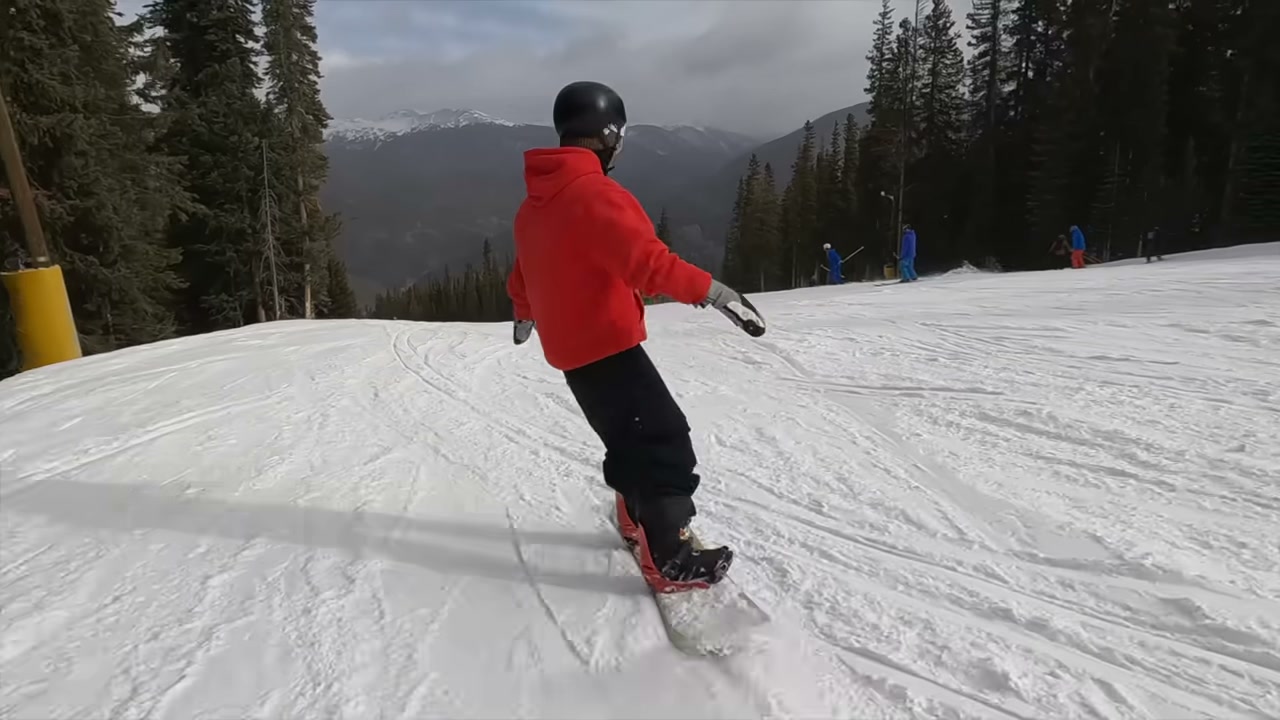
One of the video’s pet peeves is people coming up from behind and yelling or clicking their poles to get the person in front to move (9:00). His comparison is a car sitting on your bumper flashing its lights. It is not the slower driver’s job to get out of the way. You find a safe place to pass.
It is worse than rude, too. As he explains at 9:28, someone startled from behind tends to look round or make a sudden movement, and that can be exactly what makes them catch an edge.
Being below does not mean switching off
Priority is not the same as no responsibility (10:02). Even as the person below, you keep looking around, the way you check your mirrors in a car.
In crowds, he recommends using your “blinker” (13:46). Before a big change of direction, look over your shoulder, and if someone is there, point the way you are about to go (13:54). The people behind are still responsible for not running you over, but as he says, showing them what you are about to do is how you look after yourself.
How do you overtake on the piste?
Overtaking is allowed. FIS rule 4 says you can pass on either side, above or below. The condition is room, enough space for the person you are passing to make any movement, whether they mean to or not.
That last part is the one to take in. Anyone in front of you can turn or fall at any moment, and they have probably not seen you. Leave room for it.
FIS’s commentary adds that the person overtaking is wholly responsible until the pass is complete, and that this applies even when the person you are passing is standing still. The video’s version (8:55) is the same idea in fewer words.
Where should you stop on a ski slope?
At the side of the piste, somewhere the people coming down can see you from a long way off. Never in a narrow section, and never just below a roller or a steep rollover where you are hidden from above.
Pick a proper spot. He suggests a marked rest area if the resort has one, the area behind a slow sign, or the side of the run (4:12). Even at the side, he leaves a bit of space between himself and the edge of the run, so anyone squeezing past on the outside has room to get by without taking him out (4:23).
Look for side hits before you stop. Plenty of runs have little natural jumps near the edge that people love to hit (4:39). Stop in front of one and you are in their way. Stand above it, or well down the hill and out of the way (5:06).
Never stop below a roller. This is the dangerous one, and the video shows why at 5:47. From below, the roller looks gentle. From above, it is an abrupt drop, and a popular little jump. Sit down just below it (he says about eight feet, 6:07) and nobody coming over the top can see you until they are already in the air. By then, as he says, they cannot change anything.
So stop above it instead, up and out of the way at the side of the run (6:36).
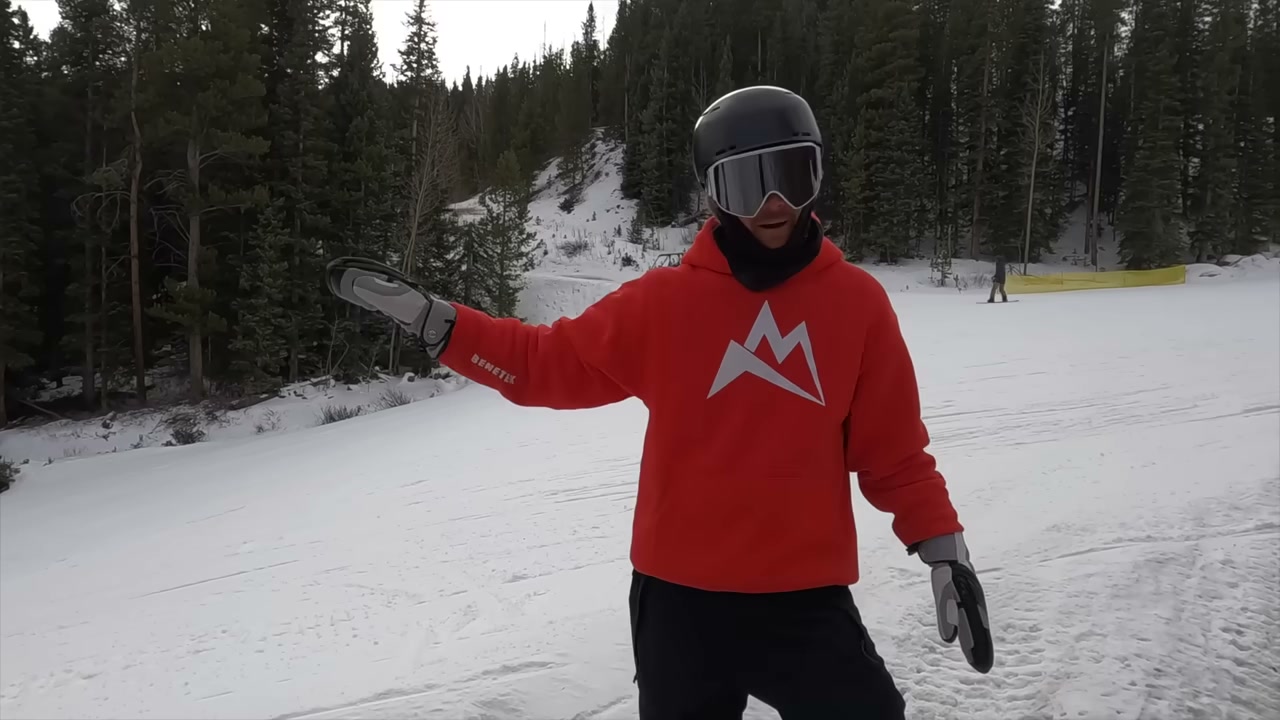
Be visible from a long way up. His rule of thumb is that you want to be seen from 50 to 100 yards away, roughly 45 to 90 metres (6:39). If someone would only spot you from a few feet away, move.
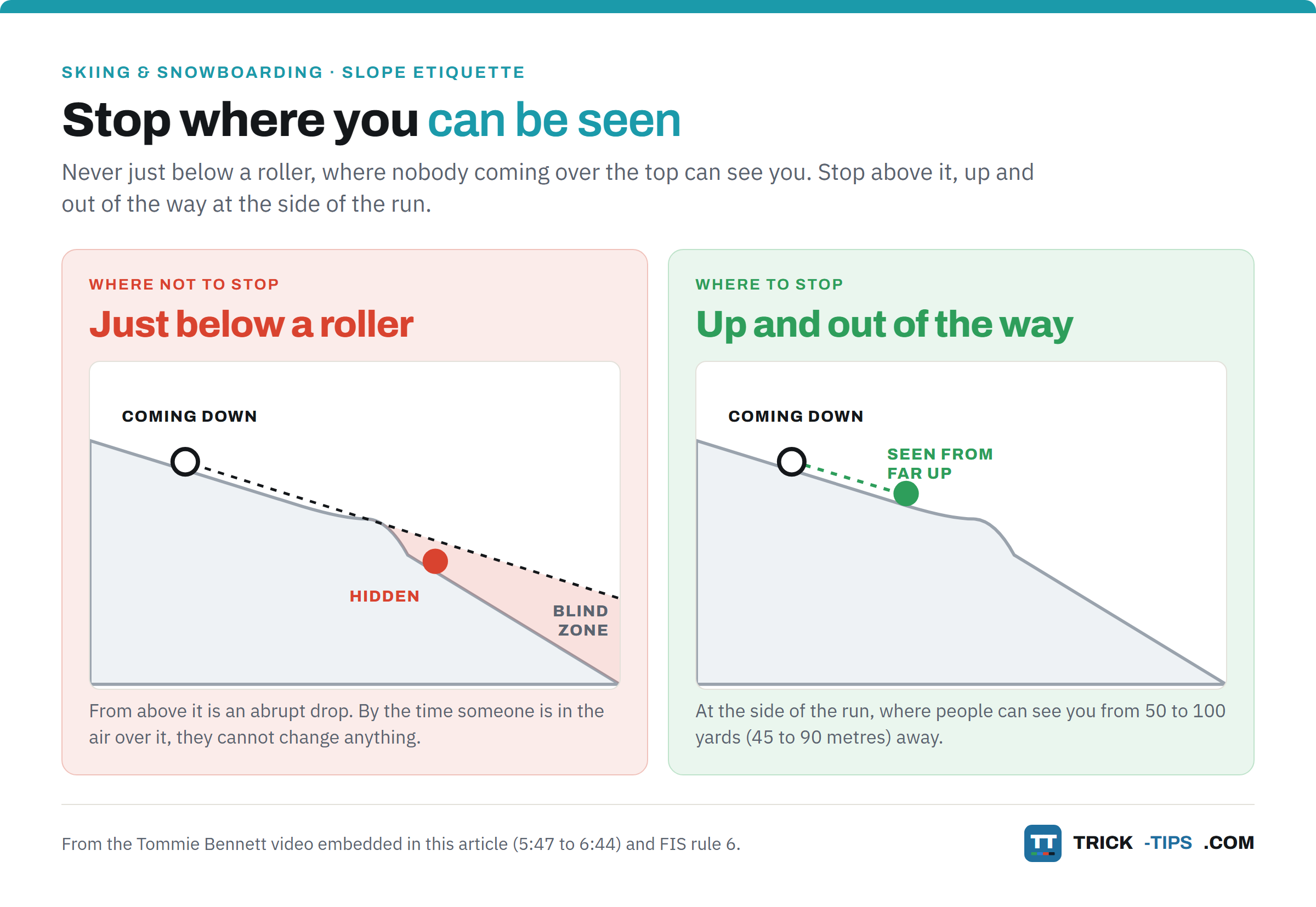
FIS’s commentary agrees. Except on wide slopes, stop at the side, and never where it is hard to be seen from above. If you fall somewhere like that, get clear as soon as you can.
Strapping in and stopping as a group
Snowboarders have to strap in, and the video’s advice (2:01) is to get out of the way to do it. If you pull in below someone who has already stopped, leave them room to get out, because a group of six stopping below someone can box them in completely (2:22). And when you stand up to go, look around first (3:31).
Joining a run and setting off again
FIS rule 5 is short, and the FIS commentary is blunt about why it exists. Experience shows that joining a slope and starting again after stopping are where accidents come from. So whenever you join a run, set off after a stop, or turn back up the hill, look up and down the slope first.
The video shows it at a junction (11:39). Look up the hill, watch the flow of traffic, wait for a gap and then slot in. Dart straight out and, in his words, you are probably going to get taken out. Because you are the one entering the run, it is your job to give way.
The same goes for side hits (12:05). The jump takes you off the main run, so when you come back in, it is your job to give way to anyone already on it, beside you, just in front or just behind. If the timing is wrong, skip the trick and save it for another run (12:38).
The good news is that it swings back your way. Once you are moving properly again, even slowly, the FIS commentary says you have the protection of rule 3 against faster people coming from above.
Wide turns on a busy run
When you are learning, you make wide turns across the hill to manage your speed. But the video points out at 6:57 that a wide turn can carry you straight into a blind zone below a roller, even if you never stop there.
His answer is to take up less width where you cannot be seen, and save the wide turns for where you can (7:19). As a run gets busier, he deliberately takes up less room (7:28). If you are still working on turn shape, our guide to linking turns on a snowboard covers using it to control your speed.
FIS’s commentary on rule 2 adds where to slow right down, in crowded areas, wherever you cannot see far, at the edge of a steep slope, at the bottom of a run and around the lifts.
On the lift and in the queue
The video opens and closes with lift manners.
- Warn people before you put the chairlift bar down (1:07). They may be adjusting their boots or bindings.
- Do not slam your board on the snow to knock the ice off (10:41). He says a hard slap can break a binding (11:01). Pick the ice out with your ratchet instead.
- Keep your speed down in the queue (14:38), so you are not running into the back of someone’s skis or board.
- Carry your skis upright (15:04). Across your shoulder, they swing into somebody’s head the moment you turn.
Not sure how a lift works? Ask the lift attendant. The US code makes that a point of its own.
What to do if there is an accident
The video does not cover this, so this section comes from the FIS rules and their commentary, and from the Ski Club of Great Britain’s piste safety advice.
FIS rule 9 says that at an accident, every skier and snowboarder is duty bound to help. Here is what that looks like.
- Make the spot safe. Mark it above the injured person so people coming down see it in time. Stick your skis upright in the snow in a cross, or stand your snowboard upright, a few metres uphill of them. If you need to, put someone further up the slope to warn people.
- Get help coming. Contact the resort’s emergency service, the ski patrol or piste rescue, or send someone to the nearest lift attendant. Tell them the name of the piste, the nearest piste marker or lift pylon, and what has happened.
- Stay with them. Give what first aid you can, keep them comfortable and reassure them that help is on the way.
- Swap names and addresses. FIS rule 10 applies to everyone involved and to every witness, whether they were at fault or not.
Never just ride off. FIS goes as far as saying it hopes leaving the scene of a ski accident will one day be treated like a hit and run on the road.
If you were in a collision yourself, the FIS commentary says witnesses, rescue service reports and photographs all help decide who was liable. UK solicitors Penningtons Manches Cooper also advise telling your insurer, whoever was at fault.
In the park the drill is a little different, with the X signal and someone closing the feature. That is all in our terrain park etiquette guide.
The mistakes that cause collisions
Stopping just below a roller or mid-run. You are invisible until someone is on top of you. Move to the side (5:47).
Shouting or clicking your poles at someone. Passing safely is your job, not theirs (9:00).
Darting into a run without looking uphill. Look, wait for a gap, then go (11:52).
Landing a side hit back into the traffic. You left the run, so you give way coming back in (12:14).
Boxing people in with your group. Stop together at the side, out of the way (2:22).
Changing direction suddenly in a crowd. Look over your shoulder and signal first (13:54).
Where this sits
Etiquette is the rung under everything else on the hill, whether you are on skis or a board.
- On a board, your first turns and then linking turns are where you start crossing the whole width of the piste.
- On skis, how to carve on skis is the next step once you are linking parallel turns. A carved turn can take you back up the hill, which FIS rule 5 says needs a look up and down first.
- Heading for the park? Terrain park etiquette covers the park’s own rules, from claiming a drop to where you can stop near the features.
What to practise
On your next day out, make two habits automatic.
Every time you stop, ask yourself one question. Could someone coming down see me from a long way up? If not, move.
Every time you set off or join a run, look up the hill first and wait for a gap.
Frequently Asked Questions
Who has right of way on a ski slope?
The person below you, or ahead of you, has priority. If you are coming from above, it is your job to choose a line that avoids them and leaves room for any turn or fall they make. That is FIS rule 3, and the US Responsibility Code says the same thing.
Where should you stop on a ski slope?
At the side of the piste, somewhere people coming down can see you from a long way up. Never stop in a narrow section or just below a roller or bump, where you are hidden from anyone above. If you fall in a spot like that, get clear as soon as you can.
Do skiers and snowboarders follow the same rules?
Yes. The FIS rules are written for skiers and snowboarders together, and the US Responsibility Code covers everyone using the slopes. The one extra for snowboarders is strapping in, which is best done at the side of the run, out of everyone’s way.
Who has priority when you join a run or set off again?
The people already moving down the slope. Look up and down before you join a run or set off after stopping, and wait for a gap. Once you are moving properly again, even slowly, FIS gives you the same priority as anyone else below.
What should you do if you see an accident on the piste?
Stop and help, which FIS rule 9 says every skier and snowboarder is duty bound to do. Mark the spot a few metres above the injured person with crossed skis or an upright snowboard, call the resort’s emergency service or tell a lift attendant, and stay with them until help arrives. Afterwards, everyone involved and every witness swaps names and addresses.
What is the difference between the FIS rules and the Responsibility Code?
The FIS rules are the international code, published by ski areas across Europe, the UK and beyond. The Responsibility Code is the US version from the National Ski Areas Association, and Canada’s ski areas use the same ten points. They agree on the big ones, priority for the person below, stopping where you can be seen and looking uphill before you start. The US code adds points on lifts, closed areas, runaway equipment and alcohol or drugs.
In short
The person below has priority, so you avoid them. Stop at the side, where you can be seen from far up the slope, and never below a roller. Look uphill before you set off or join a run. And if someone is hurt, stop, mark the spot above them and get help coming.
Ask any questions in the comments below.